


There is always that point in the year when getting dressed suddenly becomes more complicated.
The mornings are cooler, the afternoons can still feel mild, and the pieces you relied on throughout summer no longer quite work on their own. But it is not cold enough to completely change how you dress either.
For us, this is where a good wardrobe really earns its place.
At No2moro, we have always believed that the strongest wardrobes are not built around individual seasons. They are built around foundations — pieces that work throughout the year and can be layered, adapted and restyled as the weather changes.
A transitional wardrobe is simply an extension of that idea.
It is not about putting one wardrobe away and replacing it with another. It is about having enough versatility in what you already own to move comfortably from one season into the next.
Start With the Pieces You Wear All Year
The most useful transitional wardrobes begin with the least seasonal pieces.
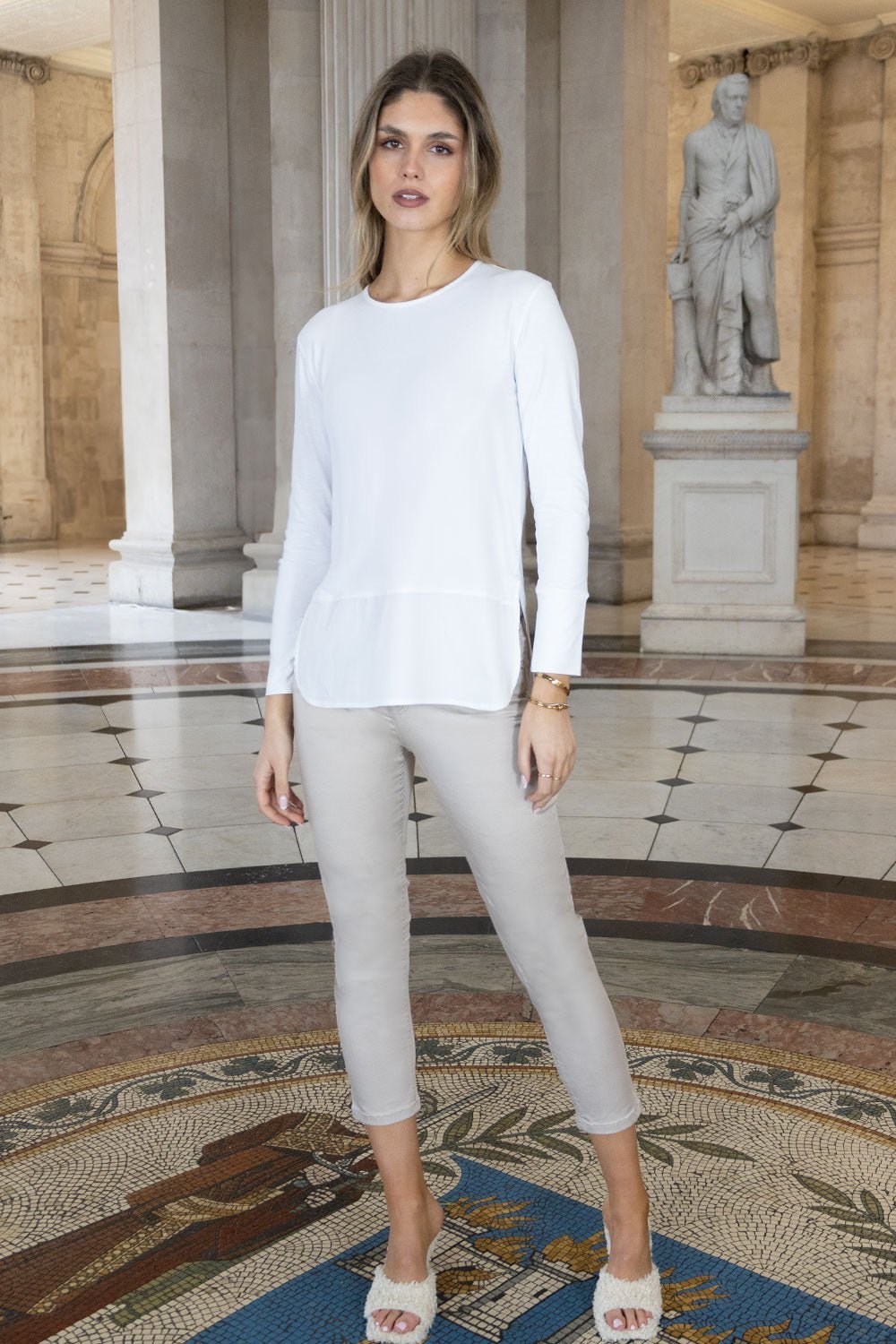
A good cotton top. A soft long-sleeve layer. A simple shirt. A well-cut trouser. A comfortable pair of jeans.
These are the pieces that sit underneath everything else, and because they are worn so frequently, this is where quality matters most.
We often describe them as Foundational Wardrobe Essentials because that is exactly what they are. They do not necessarily make the loudest statement in an outfit, but they are the reason the rest of the wardrobe works.
When the weather changes, you should not need to rethink these pieces. You simply change what goes around them.
That is why we have always put so much emphasis on fabrics, fit and versatility in our Basics & Tops collections. If a piece can be worn comfortably on its own, underneath a knit, beneath a jacket or layered with a shirt, it has a far longer life in your wardrobe than something designed for one very specific moment.
Layer Rather Than Dress for One Temperature
One of the easiest mistakes to make during transitional weather is dressing for the temperature when you leave the house.
By lunchtime, everything has changed.
Layering solves that problem because it gives you options.
A lightweight base can be worn underneath a shirt. A shirt can sit open over a simple top. Knitwear can be added when temperatures drop and removed again when they rise.
The best layers should never feel bulky or restrictive. Each piece needs to work independently while also sitting comfortably with the next.
This is something we think about constantly when designing at No2moro.
Layering should feel effortless rather than complicated.
If you are unsure which type of base works best beneath the pieces you already own, our The No2moro Layering Guide compares our different Foundation fabrics, fits and layering shapes
It is one of the reasons we return again and again to smooth, comfortable fabrics and shapes that can be worn in several different ways.
A wardrobe becomes much more useful when the same pieces can move between being the base of an outfit, the middle layer and, occasionally, the finishing piece.
Keep Knitwear Flexible
Knitwear becomes particularly useful during the change between seasons because it adds warmth without immediately pushing an outfit into full winter dressing.
The key is versatility.
Rather than thinking only about heavy winter knits, look for pieces that can sit comfortably over shirts and lightweight tops and that can still be worn underneath a coat later in the year.
Different shapes also serve different purposes.
A cardigan creates a removable layer. A sleeveless knit adds warmth while leaving the outfit lighter. A jumper gives you a simple extra layer that can be worn repeatedly with different pieces underneath.
Colour can also play an important role here.
The rest of a transitional wardrobe may be relatively neutral, so knitwear is often where you can introduce stronger colour, texture or personality without limiting how often the piece can be worn.
A good knit should not dictate the entire outfit.
It should simply make the pieces you already own more useful.
Let Your Trousers Anchor the Outfit
As the weather cools, trousers naturally begin to take a bigger role in the wardrobe.
What matters most is not having endless variations, but having a small number of reliable shapes that work with the tops and layers you already own.
A straight leg gives you a clean everyday silhouette. A wider leg can create a softer, more relaxed shape. Denim adds structure and is particularly useful when you are moving between casual and more polished dressing.
The important thing is consistency.
If the trousers in your wardrobe work with your cotton basics, shirts, layering tops and knitwear, getting dressed becomes much easier.
You are no longer creating completely new outfits every time.
You are simply rearranging a small number of pieces that already work together.
That is one of the ideas behind our approach to designing trousers and denim. The goal is not to reinvent the silhouette every season, but to create shapes that can remain useful as the rest of your wardrobe changes around them.
Shirts Become Particularly Useful Between Seasons
There are few pieces more useful during transitional weather than a good shirt.
Worn buttoned, it can form the main part of an outfit. Left open, it becomes a lightweight jacket. Under knitwear, it adds shape and structure. Later in the year, it becomes another layer underneath heavier outerwear.
This is why shirts have always played such an important part in our collections.
The best ones are not really seasonal.
A white cotton shirt can be worn in spring, summer, autumn and winter. What changes is simply how you wear it.
In warmer weather it can stand alone.
As temperatures begin to fall, it becomes part of the layering system around it.
That is exactly the kind of versatility we look for when developing a piece.
Use Fabric to Change the Feel of an Outfit
Transitional dressing is not only about adding more clothing.
Sometimes the fabric itself is enough to make an outfit feel appropriate for a different time of year.
Cotton remains one of the most useful fabrics in any wardrobe because it works across so many temperatures. Lightweight stretch fabrics are particularly valuable for layering because they sit smoothly underneath other garments. Denim adds structure and weight. Knitwear introduces warmth and texture.
Combining these different materials is often more effective than relying on one heavy piece.
A cotton shirt with a lightweight base underneath and knitwear over the top gives you three layers that can be adjusted throughout the day.
It also creates far more outfit combinations from the same small wardrobe.
This is where buying fewer, better pieces begins to make sense.
The more compatible the fabrics, shapes and colours are with each other, the more outfits you can create without continually adding something new.
Do Not Pack Away Your Summer Wardrobe Too Quickly
Some of the best transitional pieces may already be sitting in your summer wardrobe.
Lightweight shirts, simple tops and lighter colours can continue well into autumn when they are styled differently.
A pale shirt that felt summery with lightweight trousers can feel completely different beneath knitwear or paired with darker denim.
A simple sleeveless or short-sleeve base can continue to be useful beneath jackets, shirts and knits long after you would wear it on its own.
This is one of the reasons we design so many pieces without a strict seasonal identity.
Clothes should not suddenly become irrelevant because the calendar changes.
The more ways you can wear something, the more valuable it becomes.
Add Seasonal Pieces Around Strong Foundations
We love designing seasonal pieces.
They are where colour, texture, print and new shapes can come into the collection.
But we have never believed that an entire wardrobe should be made up of them.
Our approach has always been Foundations first.
Once those foundations are in place, seasonal pieces become much easier to wear because they already have something to work with.
A stronger knit can sit over a familiar shirt. A new jacket can immediately work with the denim already in your wardrobe. A seasonal colour can be introduced without having to build an entirely new outfit around it.
This is also why many of our more individual designs are produced in limited quantities.
They are designed to add something new to the wardrobe rather than replace the pieces that already make it work.
Think in Outfits, Not Individual Pieces
One of the most useful things you can do when buying something new is to stop looking at it in isolation.
Ask yourself what you would wear underneath it.
What would you wear over it?
Which trousers or jeans already in your wardrobe would work with it?
Could you wear it now?
Could you still wear it three months from now?
If a piece works in several combinations, it is far more likely to become part of your everyday wardrobe.
This is especially important during transitional months, when every outfit needs a little more flexibility.
The strongest wardrobes are rarely the biggest ones.
They are the ones where the pieces understand each other.
A Wardrobe Designed to Move With You
The change between seasons does not have to mean starting again.
In many ways, it is the best opportunity to see whether your wardrobe is really working.
The pieces you reach for during these months tend to be the ones that are comfortable, adaptable and easy to combine.
Those are the clothes worth building around.
At No2moro, that has always been our approach.
Strong foundations. Good fabrics. Thoughtful layers. Seasonal pieces with individuality.
Clothes designed to work together — and to keep working long after one season has moved into the next.